Ibrahim Ansari
baconhead
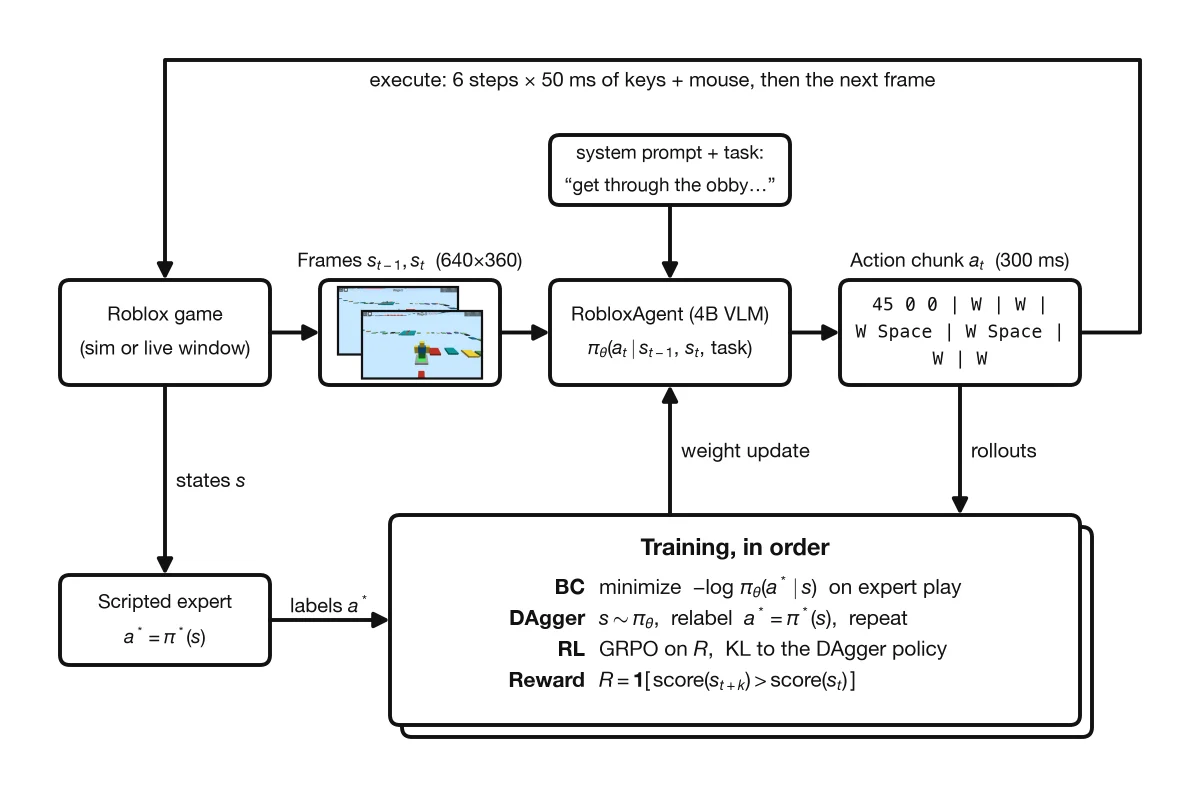
I trained a 4B vision-language model to play Roblox. It looks at the screen, reads a one-line task, and types out what to do with the keyboard and mouse for the next 300 ms. It has no access to game state, but I distilled game physics into the model.
The project started because my friend stole one of my rare brainrots in Steal a Brainrot when I went afk.
The reason why I chose Roblox specifically is that it is an ideal RL environment. A lot of work I see on games usually involves Minecraft or some gym environment (the ones from OpenAI), which don't generalize the same game physics to other games. The closest thing I've seen is Lumine (Tan et al. 2025), a VLM that plays Genshin Impact from raw pixels with keyboard and mouse and transfers zero-shot to other open-world games. Roblox has a bunch of games, so self-play and training on behaviour matters much more, and having to actually observe your state rather than all the info being passed to the agent I think makes it fundamentally match an MDP much more.
What the model sees
Every 300 ms the model gets two 640×360 frames, the one from the last decision and the current one, so it can tell which way things are moving. It answers with a single line:
45 0 0 | W | W | W Space | W Space | W | WThe first three numbers are camera yaw and pitch in tenths of a degree, plus scroll. Then come the keys to hold for each of six 50 ms steps. I went with plain text instead of a custom action head because it's only about 20 tokens, and it lets the model reuse everything it already knows about reading a screen. The policy is just next-token prediction over that line:
$$\pi_\theta(a_t \mid s_{t-1}, s_t) = \prod_j \pi_\theta(y_j \mid y_{<j}, s_{t-1}, s_t)$$You can't train on live Roblox servers, so I built ten small Roblox-style games in Python: an obby, doors, rivals, Steal a Brainrot, etc. Each one has a scripted expert. Multiplayer games include scripted NPC players running on identical physics. The expert decides every 100 ms, so three of its decisions make one chunk, each held for two 50 ms steps. Labels and the model's actions go through the same function that steps the game, so training and play can't disagree about what a chunk means. The game state also freezes while the model decides its next action.
Training
Training is one pipeline with three stages, each there because the previous one hit a wall.
Behaviour cloning. First, plain cross-entropy on the expert's actions:
$$\mathcal{L}_{\text{BC}} = -\,\mathbb{E}_{(s, a^*)}\Big[\sum_j \log \pi_\theta(y^*_j \mid y^*_{<j}, s)\Big]$$Two small things made this work much better. 20% of the time, the expert plays a noisy action (the camera nudged by about 10° and one key flipped) while the label stays clean, so the data shows how to recover from mistakes instead of only how to avoid them. And since obby play is mostly holding W, I keep the $k$-th identical chunk in a row with probability $0.5^{k-1}$, so walking doesn't drown out the jumps.
DAgger. BC only ever sees states the expert visits. Once the model makes one mistake it's somewhere it has never been, so it makes more, and over a $T$-step episode the errors grow like $O(\varepsilon T^2)$. DAgger (Ross et al. 2011) fixes this by letting the model drive. In round $k$ the expert takes over with probability $\beta_k = 0.5^k$. Every state the model reaches gets relabelled with what the expert would have done, $a^* = \pi^*(s)$, and goes into the training set. That brings the growth down to $O(\varepsilon T)$, which matters a lot when $T$ is a 60-second episode. The original paper tested it on Super Tux Kart (an open-source Mario Kart clone) and Super Mario Bros. Plain supervised Mario kept getting stuck against obstacles, because the expert always jumped well before reaching them, so it never showed what to do right next to one. DAgger fixed that, and its kart stopped falling off the track entirely after 15 rounds.
I evaluate on five obby levels the model has never seen, 60 seconds each.
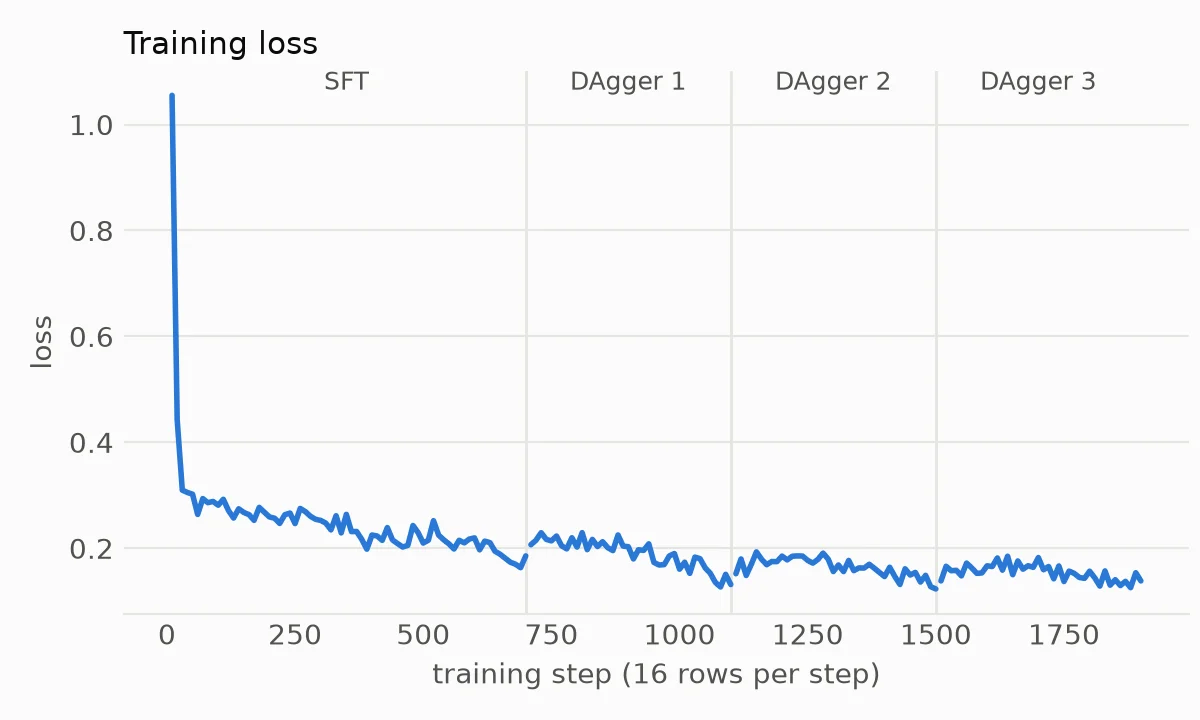
The mean sat at exactly 3.8 for BC and the first two DAgger rounds while individual levels moved around a lot, then jumped.
Imitation is capped by the expert. The model can only get as good as the script it copies, so the last stage throws the labels away and trains on the game itself, with the simplest reward I could defend:
$$R = \mathbf{1}\big[\text{score}(s_{t+k}) > \text{score}(s_t)\big]$$Meaning 1 if you reach the next checkpoint and 0 if you don't. The catch is GRPO's advantage. For 8 episodes from the same start state,
$$A_i = \frac{R_i - \operatorname{mean}(R)}{\operatorname{std}(R)}$$so if all 8 succeed, or all 8 fail, every advantage is zero and nothing is learned. Starting episodes from the beginning of a level, almost everything fails. So episodes start partway through the expert's own run, $k$ decisions before a checkpoint. Early on $k = 2$, two good moves from success. Every 250 steps $k$ doubles, up to 64, which is close to playing a whole section alone. A KL penalty of 0.01 keeps the policy near the DAgger model while it explores. It runs fully async on two H100s with miles: one GPU trains while the other plays, and truncated importance weights correct for rollouts that are a few updates stale.
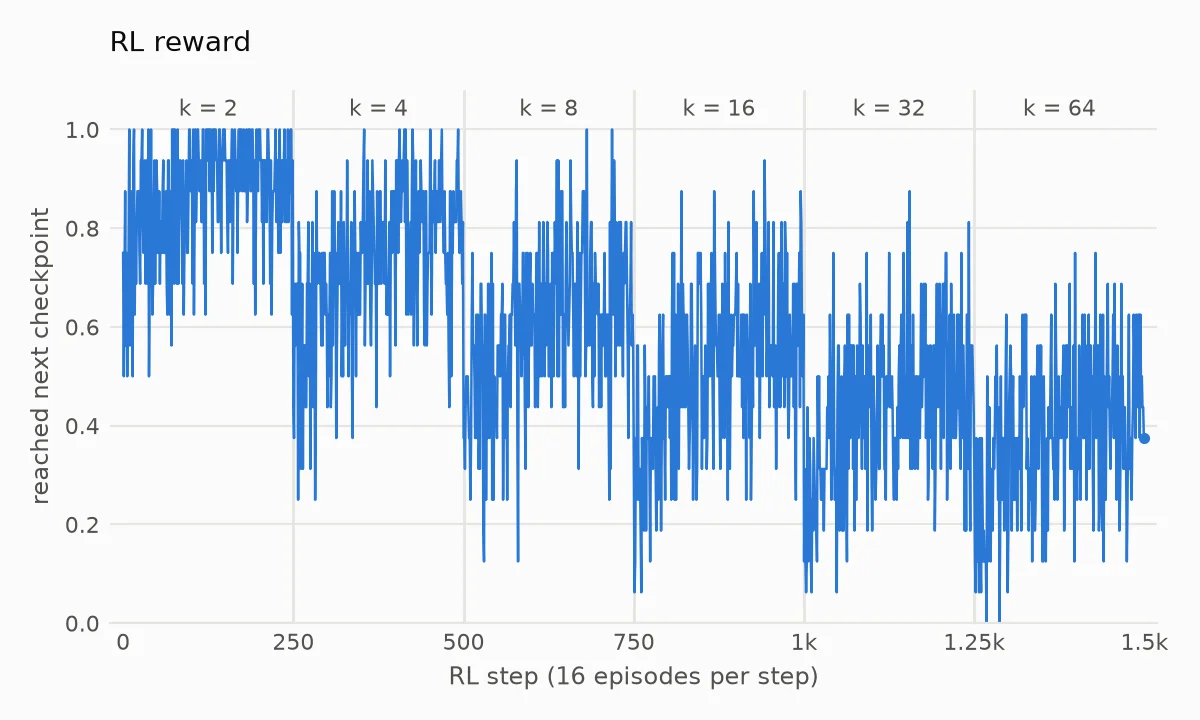
Each time $k$ doubles, success drops because the model now starts further from the checkpoint, and then it climbs back as GRPO finds the moves that work from there. What matters is that the climb keeps happening at $k = 32$ and $64$. If the curve flattened there, the model would just be memorizing the last few seconds before each checkpoint rather than learning to play. It held: held-out obbies went from 7.4 to 9.5 stages, with deaths falling further, since RL mostly fixes the jumps the expert itself was sloppy on.
Results and considerations
On five held-out obbies, the model went from 0 stages to 3.8 with BC, 7.4 with DAgger, and 9.5 after RL, with deaths falling from 18.4 to about 7 a minute. The process that I ended up with came after trying different methods, like OPD with better models (like Astra and DeepSeek V4.1) and full RL (which failed because if my reward was too difficult then such a small model would get no advantage or just reward hack if I had an easier reward function with partifal credit i.e. figuring out that if it just stayed in place and jumped it would get partial credit). Next I want to run this on Roblox, hopefully with enough compute to serve the model near real-time, and also add more mouse movement dependent environments.
If you want to do something similar to this, I would highly suggest using Modal, since they give you $30 a month.
While I was making this, a very similar paper came out, Script2Play (Liu et al. 2026), and the idea of starting with BC came from them.
Code and weights: github.com/ibrahimansr/baconhead · huggingface.co/ibrahimansr/robloxagent (note that the vision encoder adds more parameters)